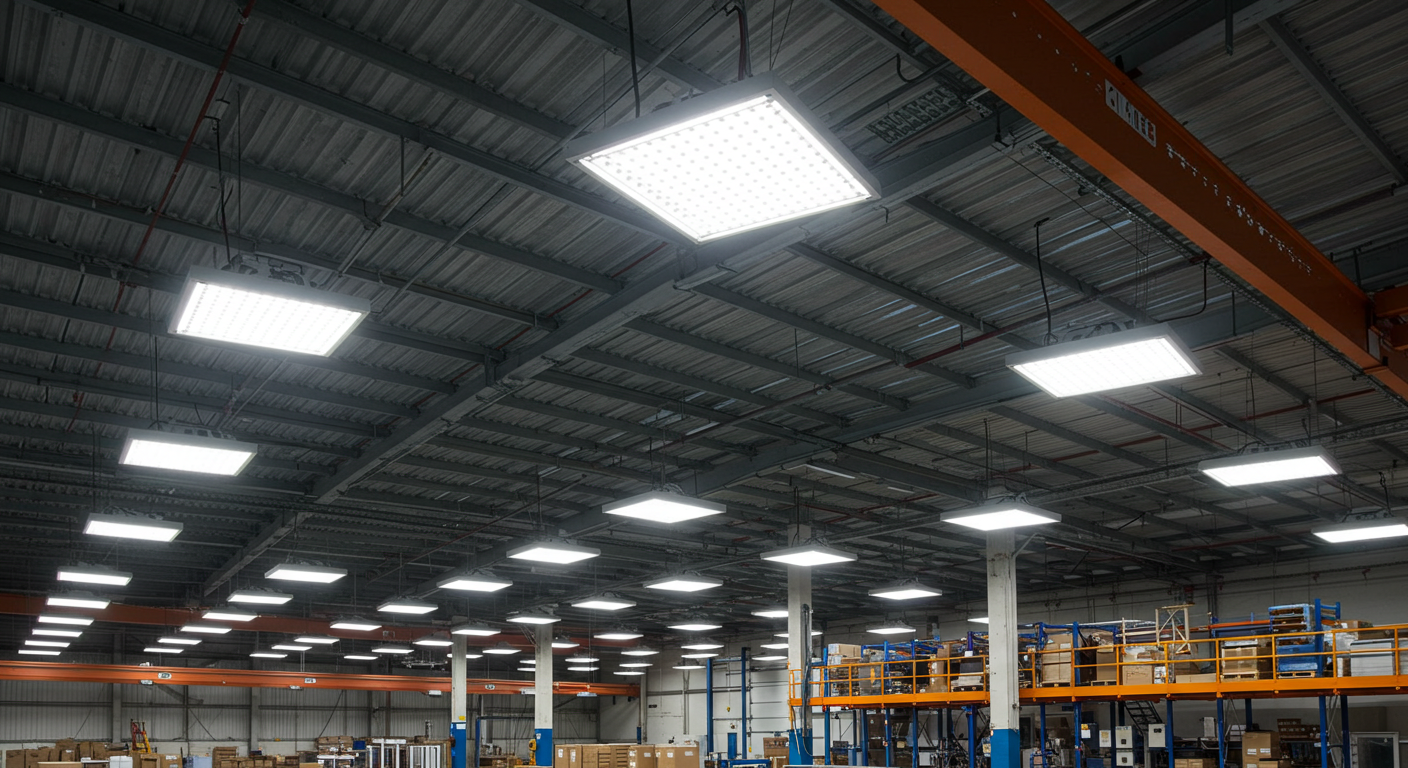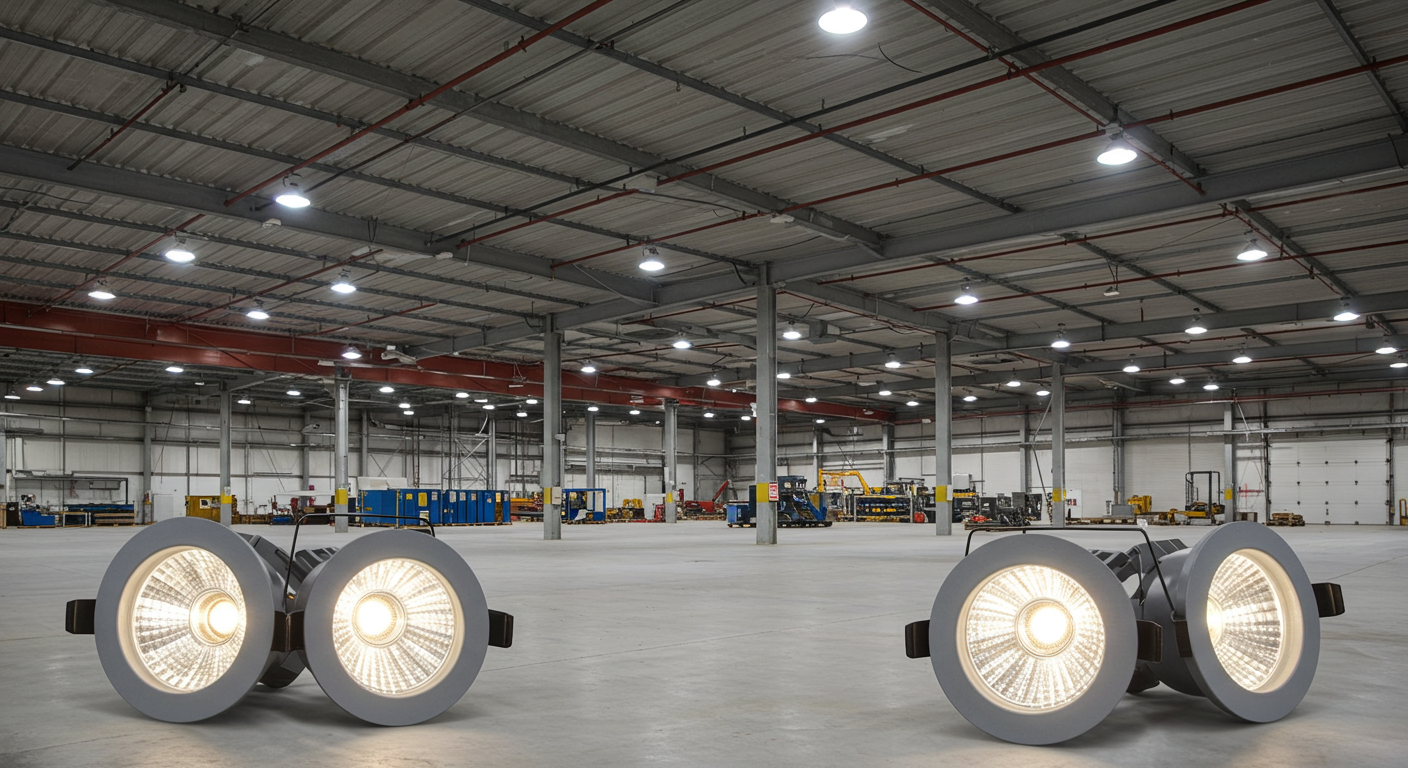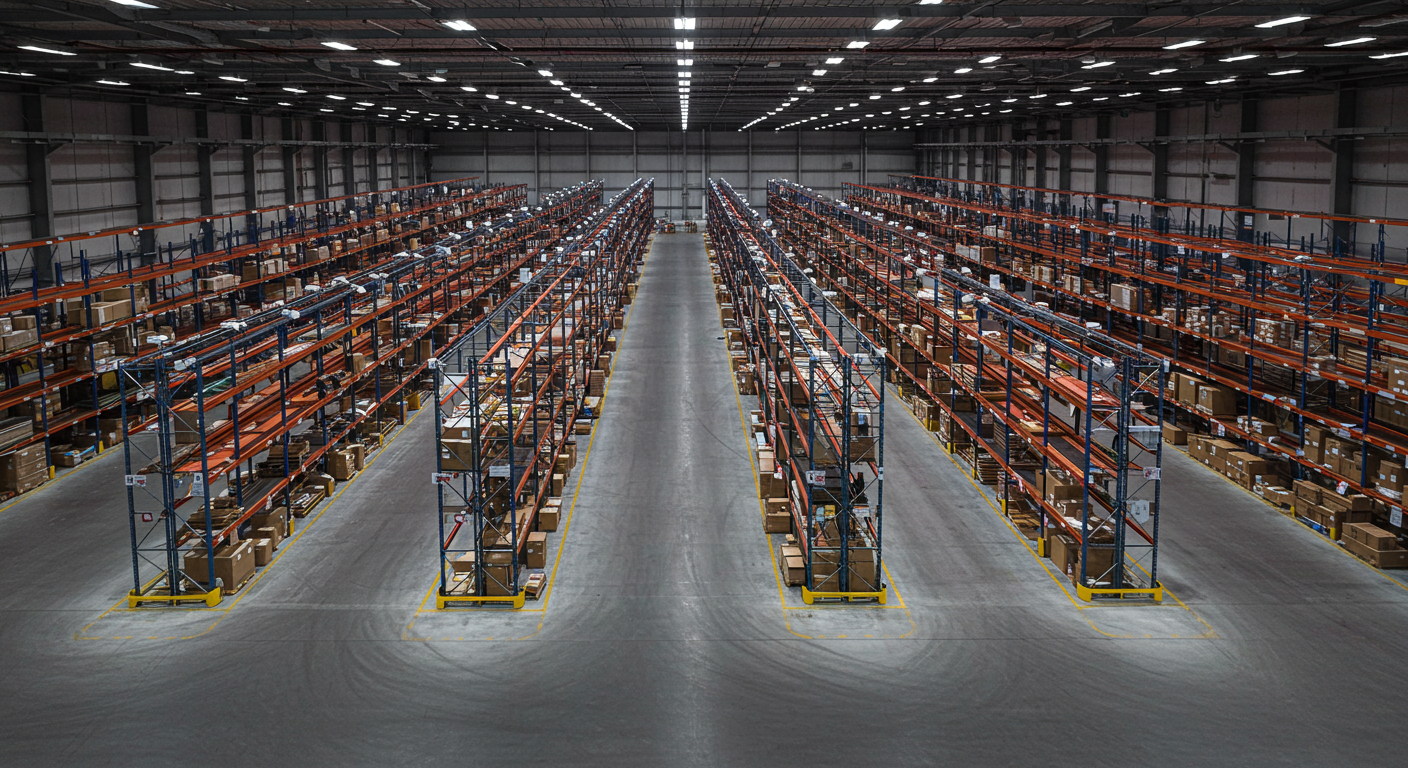
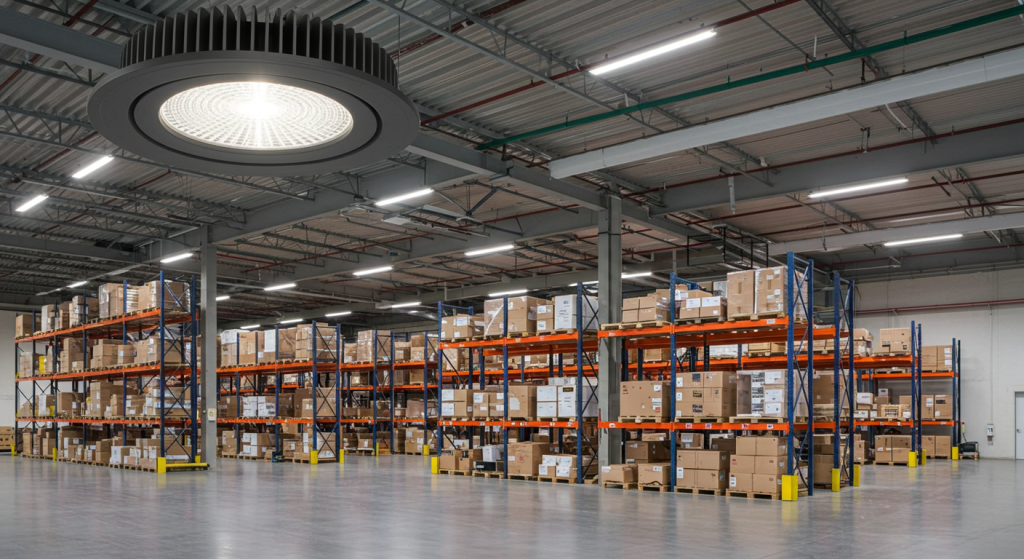
Rows of towering shelves line the floor, their narrow aisles winding like a labyrinth. Workers hustle through the chaos: forklifts hum as they glide past, boxes teeter in precarious stacks, and inventory moves at a relentless pace. It’s a hive of activity, the pulsing heart of businesses from retail to logistics. Now, picture navigating this whirlwind under dim, flickering lights. It’s like wandering through a foggy night with a weak lantern—frustrating, slow, and risky. One wrong step, one misread label, and the whole operation stumbles.
Poor lighting isn’t just a minor annoyance in warehouses; it’s a silent saboteur. Workers squint to read fine print, miss hazards lurking in shadows, and fumble through tasks that should be straightforward. The stakes are high: according to the Occupational Safety and Health Administration (OSHA), inadequate lighting ranks among the top culprits behind workplace injuries in industrial settings. Think trips over unseen obstacles, collisions between forklifts, or even a worker misjudging a stack’s height. But flip on bright, dependable lights, and the scene transforms. Suddenly, aisles are clear, labels pop, and everyone moves with confidence. It’s a game-changer.
For years, warehouses leaned on traditional lighting like metal halide (MH) or high-pressure sodium (HPS) lamps. They were the go-to, casting a familiar glow over industrial floors. But they came with baggage: soaring energy costs, bulbs that burned out too fast, and light quality that swung between harsh and patchy. Enter high power LED downlights—a modern marvel that’s rewriting the rules. These aren’t just lights; they’re a revolution in efficiency, safety, and savings. If your warehouse is still stuck in the dark ages, you’re about to see why LEDs are the upgrade you didn’t know you needed.
In this deep dive, we’ll unpack why LED downlights are taking warehouses by storm. We’ll pit them against old-school options, explore how they transform daily operations, and show you the numbers that prove their worth. Expect detailed breakdowns, real-world stories, and even a few practical tips to light up your space. Let’s get started!
Why Lighting Matters More Than You Think
Warehouses aren’t your average workplace—they’re industrial beasts with unique demands. Picture a space where ceilings climb 20, 30, even 40 feet high, dwarfing everything below. Shelves stretch to the rafters, packed tight with goods, leaving slim aisles that twist through the floorplan. Workers dart between them, some on foot juggling handheld scanners, others steering forklifts loaded with pallets. It’s a high-stakes ballet of motion and precision, and lighting is the unsung hero holding it together.
The Dark Side of Bad Lighting
When lighting falters, chaos creeps in. Dim corners breed shadows—perfect hiding spots for a stray box, a slick patch of floor, or a low-hanging beam. Uneven light throws off depth perception, turning a simple forklift turn into a collision waiting to happen. Flickering bulbs? They’re a nightmare—triggering eye strain, headaches, or even dizziness mid-shift. Imagine a worker, bleary-eyed from squinting at faded labels, picking the wrong item. That’s a returned order, a frustrated customer, and a hit to your bottom line.
Safety’s the big concern here. OSHA data ties poor lighting to incidents like slips, trips, and falls—common warehouse woes that rack up injuries and downtime. A 2019 report flagged lighting as a factor in nearly 20% of forklift-related accidents. Then there’s productivity: dim light slows workers down as they double-check barcodes or hunt for items in murky zones. It’s like asking them to run a race with one hand tied behind their back.
The Bright Side of Good Lighting
Now, crank up the lumens, and watch the magic happen. Bright, steady light wipes out shadows, turning every aisle into a clear path. Workers spot hazards, read labels in a snap, and move faster without second-guessing. It’s not just about avoiding accidents—it’s about efficiency. A well-lit warehouse hums; orders fly out the door, errors plummet, and the whole operation feels sharper. Studies back this up: the Lighting Research Center found that quality lighting can boost worker output by up to 10%. That’s real time and money saved.
Traditional lights like MH and HPS ruled the roost for decades, pumping out raw power to flood these massive spaces. But they were clunky—energy hogs that flickered, faded, and demanded constant upkeep. High power LED downlights? They’re leaner, smarter, and built for the job. Let’s see how they stack up.
LED Downlights vs. Traditional Lighting: The Showdown
So, what makes LED downlights the new champs? Let’s throw them in the ring with MH and HPS lamps and break it down across the stats that matter: energy, lifespan, quality, and more.
Energy Savings: Less Power, More Punch
Old-school lamps like MH and HPS are energy guzzlers. A 400-watt MH bulb might light up a warehouse bay, but it’s chugging power like a V8 engine. Swap it for an LED downlight, and you’re down to 170-210 watts for the same brightness—nearly half the juice. Scale that up: a 1000-watt HPS monster can be matched by an LED pulling under 500 watts. Multiply that across dozens or hundreds of fixtures, and the savings stack up fast.
But wattage is only half the story. LEDs shine smarter, not just harder. Traditional lamps spray light everywhere—up to the ceiling, into the rafters, places it’s wasted. LEDs focus it downward, right where workers need it. The U.S. Department of Energy says this directional edge can cut energy use by up to 75% in some setups. For a warehouse running lights 24/7, that’s thousands of dollars staying in your pocket.
Take a hypothetical 50,000-square-foot warehouse with 100 fixtures. At 400 watts each, MH lamps burn 40,000 watts total. LEDs at 200 watts each drop that to 20,000 watts. Running 12 hours a day, 365 days a year, at $0.12 per kilowatt-hour, MH costs $21,024 annually. LEDs? Just $10,512. That’s $10,512 saved every year—enough to buy a forklift or two.
Lifespan: Lights That Last
Replacing bulbs in a warehouse is a logistical headache. You’re hauling out scissor lifts, pausing operations, and burning through maintenance hours. MH and HPS lamps clock out at 10,000 to 15,000 hours—about 1-2 years in a busy warehouse. Worse, their light fades over time, leaving you with a dull glow well before they die.
LEDs laugh at that. High-quality downlights last 50,000 hours or more—some hit 100,000 with the right setup. That’s 5-10 years of nonstop shine, even in round-the-clock operations. No ladders, no downtime, just reliable light. In a warehouse where every minute counts, that durability is gold.
Light Quality: Clarity Over Chaos
Ever worked under a buzzing, flickering light? It’s torture. MH and HPS can flicker or cast patchy beams, straining eyes and muddling tasks. Distinguishing a blue box from a black one under spotty light is a gamble—good luck with inventory accuracy.
LED downlights deliver smooth, steady illumination. No flicker, no headaches—just crisp, even light. They also boast a higher Color Rendering Index (CRI), often 80+, meaning colors pop true. In a warehouse sorting similar SKUs, that clarity cuts errors. A CRI of 80 beats the 20-40 of HPS lamps hands-down—it’s like upgrading from a blurry TV to 4K.
Instant On, No Waiting
MH and HPS lamps have a warm-up act—sometimes 5-10 minutes before they hit full brightness. In a warehouse kicking off a shift or rushing a last-minute order, that lag kills momentum. LEDs don’t mess around—they snap on instantly at peak power. It’s like the difference between a sluggish diesel engine and a sports car off the line.
Heat: Keeping It Cool
Traditional lamps are heat machines. MH and HPS bulbs can push warehouse temps up, forcing your HVAC to grind harder. In summer, that’s a double whammy—higher AC bills and sweaty workers. LEDs run cool, turning more energy into light, not heat. Your cooling system gets a break, and the floor stays comfortable.
Eco Bonus: Green and Clean
LEDs aren’t just wallet-friendly—they’re planet-friendly. Less energy means fewer carbon emissions. For that 100-fixture warehouse, cutting 20,000 watts could slash CO2 by 15-20 tons yearly, depending on your grid. Plus, LEDs skip the mercury found in some fluorescents, making disposal safer. Many utilities even toss in rebates for going green—check your local programs.
Comparison Table: LED vs. Traditional Lighting
Here’s the rundown in one glance:
| Feature | High Power LED Downlights | Traditional Lighting (MH/HPS) |
|---|---|---|
| Energy Use | 170-210W (for 400W equivalent) | 400W |
| Lifespan | 50,000+ hours | 10,000-15,000 hours |
| Light Spread | Focused, even | Scattered, spotty |
| Start-Up | Instant | 5-10 min warm-up |
| Maintenance | Near-zero | Frequent bulb swaps |
| Heat Output | Low | High (raises AC load) |
| Eco-Friendly | No mercury, less energy | Mercury in some, more energy |
| Color Rendering | High CRI (80+) | Low CRI (20-40) |
LEDs dominate. But why do they matter so much for warehouses? Let’s dig deeper.
Why LEDs Are a Warehouse’s Best Friend
Warehouses aren’t offices or retail stores—they’ve got grit, scale, and quirks that demand lighting tailored to the task. Here’s why LEDs fit like a glove:
1. Safety: Seeing Is Surviving
Warehouses are high-risk zones. Forklifts zip at 10-15 mph, carrying loads that could crush a car. Workers weave through tight spaces, balancing speed and precision. Poor lighting amplifies every danger—shadows hide a dropped pallet, flicker distracts a driver, dimness masks a step. OSHA ties better lighting to a 25% drop in accident rates. LEDs erase blind spots with bright, uniform coverage, cutting risks like trips (think a worker stumbling over a low crate) or collisions (a forklift clipping a rack).
2. Productivity: Work Fast, Work Right
Good light isn’t just safe—it’s a performance booster. The Lighting Research Center found that bright, high-CRI lighting lifts focus and slashes fatigue. In a warehouse, that means fewer mispicks—like grabbing a 16 oz. can instead of a 12 oz.—and quicker turnarounds. Workers say they feel sharper under LEDs, less drained after a 10-hour shift. A 10% productivity bump might sound small, but in a facility shipping 1,000 orders daily, that’s 100 extra orders nailed without adding staff.
3. Savings: Dollars and Sense
LEDs cost more upfront—$100-$200 per fixture vs. $50-$100 for MH—but the ROI kicks in fast. That $10,512 annual energy saving from our example? Add $2,000-$3,000 saved on maintenance (no bulb swaps, no lift rentals), and you’re at $13,000+ yearly. For a 100-fixture warehouse, LEDs pay for themselves in 1-2 years, then it’s pure profit. The Lighting Research Center tracked warehouses saving 60% on total lighting costs post-switch.
4. Green cred: Earth Loves LEDs
Cutting energy use shrinks your carbon footprint—a 50,000-square-foot warehouse might drop 20 tons of CO2 yearly with LEDs. No mercury means no hazmat headaches at disposal. Plus, rebates abound—some states offer $50-$100 per fixture, trimming that upfront cost.
5. Smart Tech: Lights That Think
LEDs pair with motion sensors, dimming empty aisles to 20% power, or brightening packing zones on demand. A warehouse in California used smart controls to cut energy use another 25%, per energy It’s like having a lighting butler—efficient and attentive.
Real-World Proof: An Atlanta Warehouse Glow-Up
Let’s talk reality. A 100,000-square-foot distribution center in Atlanta was limping along with 300 aging MH lamps. Light was dim, uneven—workers griped about eye strain, and pick errors hit 5% monthly. Energy bills topped $4,000 a month, and bulb swaps ate 20 maintenance hours weekly. Using the LED Warehouse Lighting Calculator, they swapped to 250 LED high bays at 200 watts each.
Post-switch, light levels soared 70%—aisles went from dingy to daylight-bright. Energy use halved to $2,000 monthly, saving $24,000 yearly. Maintenance dropped to near-zero, adding $5,000 in savings. Pick errors fell to 2%, boosting throughput by 60 orders daily. Accidents dipped 30%, and workers raved about feeling fresher. The $50,000 retrofit paid off in 18 months—a slam dunk.
Picking the Perfect LED Downlights
Not every warehouse is the same, so your LEDs shouldn’t be either. Here’s what to weigh:
- Ceiling Height: Over 20 feet? Go for 20,000+ lumens to reach the floor. Under 15 feet? 10,000-15,000 lumens might do.
- Aisle Width: Narrow slots (5-8 feet) need tight beam angles (60°); wide bays (15+ feet) can handle 120° spreads.
- Tasks: Packing or inspection zones want 500-700 lux; storage can manage 200-300 lux.
- Color Temp: 4000K-5000K mimics daylight—ideal for focus without glare.
Adjustable fixtures let you tweak angles, cutting waste and glare. A lighting pro can map it out for max impact.
Installation and Maintenance: Easy Does It
Switching to LEDs doesn’t mean tearing everything down—many retrofit into MH or HPS sockets, slashing install costs. Still, hire an electrician to nail spacing and meet codes. Too sparse, and you’ll get dark patches; too dense, and you’re overpaying. A 10,000-square-foot space might need 20-30 downlights, spaced 15-20 feet apart.
Once up, LEDs are low-drama. They shrug off vibrations and dust, lasting years without a hiccup. Just wipe them down yearly—grime can dim output 10-15%.
Going Green: The Bigger Picture
LEDs shrink your eco-footprint big-time. That Atlanta warehouse’s 50% energy cut translates to 40 tons less CO2 yearly on a coal-heavy grid. No mercury keeps landfills cleaner. It’s a win for sustainability—and bragging rights with eco-conscious clients.
Wrap-Up: Flip the Switch
High power LED downlights aren’t a luxury—they’re a warehouse essential. They slash bills, boost safety, and turn chaos into clockwork. If your space is still flickering under yesterday’s bulbs, the math says it’s time to upgrade. Sure, the upfront hit stings, but the payoff—lower costs, happier workers, greener ops—lights up the bottom line for years.
FAQ: Your LED Questions, Answered
Q: How much can I save with LEDs?
A: Expect 50-60% off energy bills, plus maintenance cuts. A midsize warehouse might save $10,000-$20,000 yearly.
Q: Are LEDs bright enough for big spaces?
A: Yep—high power models are built for 40-foot ceilings and sprawling floors.
Q: Can I phase them in?
A: Totally. Start with key zones and scale up—savings kick in either way.
Q: Do smart controls work with LEDs?
A: Like a charm. Sensors and dimmers can trim another 20-30% off energy use.
Q: Any green incentives?
A: Many utilities offer $50-$150 per fixture—check your area.
Q: How do I pick the right ones?
A: Match lumens to height, beams to width, and temp to tasks. A pro can fine-tune it.